


HUMAD
»Human Accident Dynamics«
Funding period: 2021 bis 2023
Type of project: international project
Project partners:
Contact
Dr.-Ing. Matthias Boljen
+49 761 2714-388
matthias.boljen@emi.fraunhofer.de

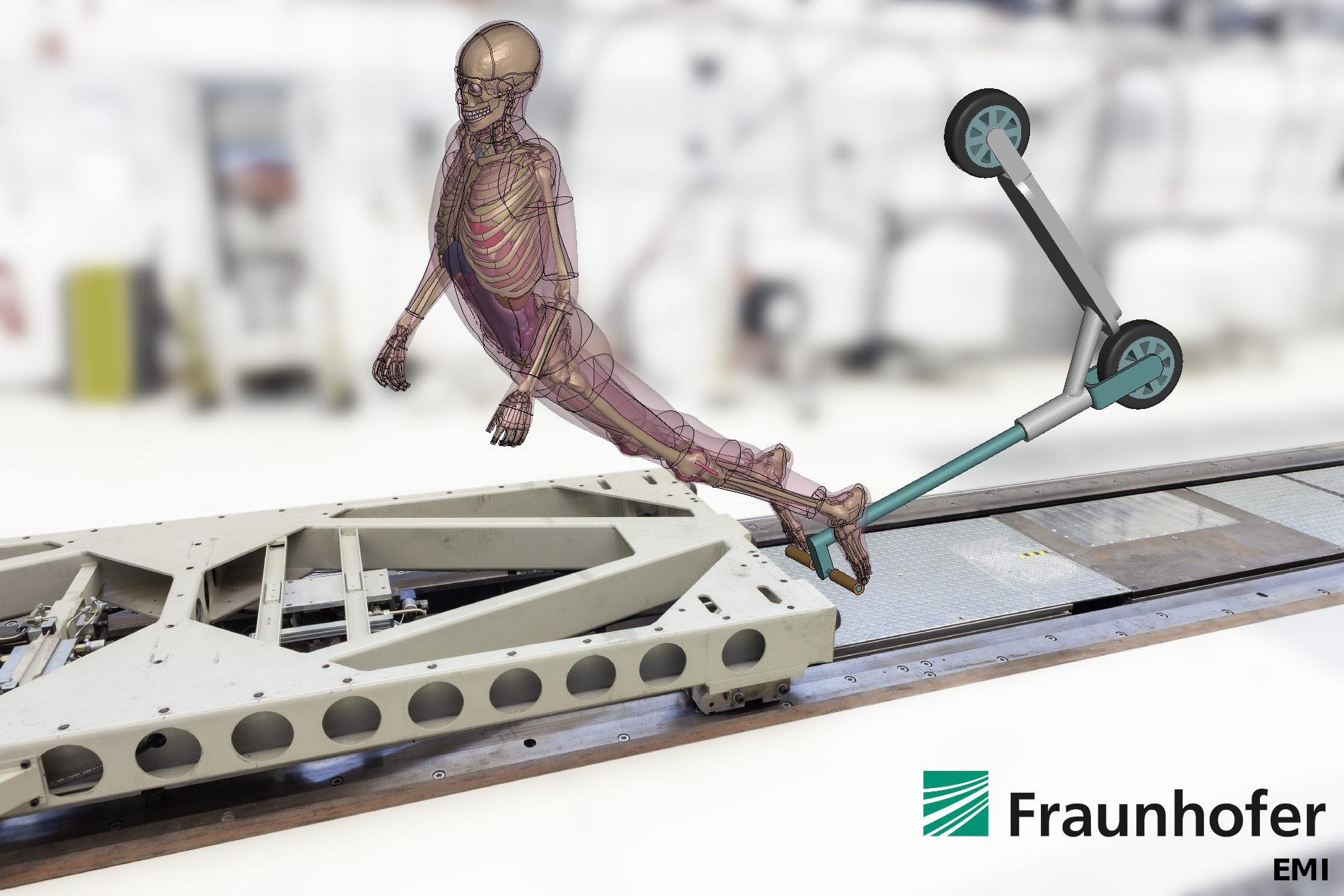
They are practical, extremely flexible and promise environmentally friendly mobility. More and more people are using e-scooters in urban traffic. Accidents involving serious injuries are also on the increase. The risk associated with these fast scooters is often underestimated. Fraunhofer researchers have now investigated a typical accident scenario and the associated injuries in the “HUMAD” project. The experts have also tested new materials for helmets and protectors. These could provide much better protection than conventional products.
The future of mobility is already on the horizon. A whole range of new vehicle types such as e-bikes, cargo bikes, electric scooters and e-scooters are whizzing through our cities. This opens up new opportunities for flexible and environmentally friendly mobility - but also new dangers and accident risks.
These dangers are clearly visible in e-scooters or “small electric vehicles”, as they are officially called. Figures from the Federal Statistical Office provide impressive proof of this. In 2020, there were a total of 2155 accidents involving e-scooters in Germany. Five people lost their lives and 386 were seriously injured. In 75 percent of these accidents, the e-scooter driver or rider was the main cause. Accidents in which the drivers lost control of their vehicle were particularly common. The causes are often excessive speed or driving in the wrong direction. Alcohol is also often involved.
Crash tests and simulations
Researchers from the Fraunhofer Institute for High-Speed Dynamics, Ernst-Mach-Institut, EMI and the Fraunhofer Institute for Mechanics of Materials IWM, both based in Freiburg, have launched a study into the crash safety of e-scooters as part of the “HUMAD” (Human Accident Dynamics) research project. The aim was to investigate the course of typical accidents, determine the associated risk of injury and at the same time examine the suitability of protective equipment such as helmets or protectors. The Fraunhofer EMI carried out the crash tests, while the team at the Fraunhofer IWM examined the protective equipment. Both institutes have many years of experience in accident research.
Dr. Matthias Boljen, head of the “Human Body Dynamics” research group at Fraunhofer EMI, and his team focused on a particularly common type of e-scooter accident using the example of a collision with a kerb: the accident without the involvement of another road user.
“We worked with a crash test dummy in the same way as for crash tests in the automotive industry. The dummy was placed on the replica model of an e-scooter and steered against an edge at an angle of 60 or 90° at speeds of 10, 20 and 30 km/h,” explains Boljen. High-speed cameras in the test show how the body flies over the handlebars, is catapulted into the air and, depending on the impact speed, flies several meters before hitting the ground. An unchecked fall onto the asphalt can cause serious injuries, particularly to the head. “Just watching the videos during the evaluation is painful,” says Boljen. The knees are also at risk of injury.
Varying the speed and collision angle
In parallel to the crash tests, Boljen and his team also analyzed the accident scenario in finite element simulations. For this purpose, the e-scooter and human were digitally simulated and the physical conservation laws for mass, momentum and energy as well as the material laws for the vehicle and human model were stored. Here too, the human model and e-scooter collided with the virtual kerb at speeds of 10, 20 and 30 km/h and an angle of 60 and 90° respectively. In the evaluation, the simulation software shows the acceleration forces acting on the head and knees. In turn, the experts can use these values to determine the probability of certain injuries to the head or knee occurring. “Both the crash tests with the dummy and the numerical simulations with the human model led to the same result,” explains Boljen. Even at an apparently low speed of just 10 km/h, an impact at a 90° angle unleashes enormous accelerations of 170 g on the human body.
Wearing protectors and a helmet is therefore highly recommended, as this reduces the likelihood of serious injuries. “However, no helmet can fundamentally prevent the impact on the brain, only reduce certain parts of it. Strictly speaking, the risk of craniocerebral trauma exists regardless of whether the rider is wearing a helmet or not,” explains Boljen.
Need for research into helmets and protectors
The researchers also found that the impact speed of the head measured in the simulation exceeded the maximum impactor speed of 5.4 meters per second, which is prescribed for the approval of bicycle helmets by the DIN EN 1078 test standard. In other words, commercially available bicycle helmets and protectors mitigate the consequences of a fall, but do not offer complete protection in the event of a collision with hard objects. This is where the expertise of the researchers at the Fraunhofer IWM comes into play. For more than 50 years, they have been analyzing materials and evaluating their suitability for specific applications. They also use crash tests or test mechanical impacts on materials. In the HUMAD project, they investigated the suitability and protective effect of new materials.
Innovative protection concepts from bionics
Dr. Jörg Lienhard, responsible for lightweight engineering in the Component Safety and Lightweight Construction business unit, explains: “Protectors often use plastics with a honeycomb structure. Our tests in the laboratory show that materials with the so-called TPMS structure (Triply Periodic Minimal Surface) provide significantly better protection against kinetic impacts.” The TPMS structure can be recognized by the repetitive “airy” open structure. This structure is particularly good at distributing the kinetic energy of impacts over the surface. In this way, it reduces the pressure on individual areas. The concept originates from bionics, i.e. it is copied from nature. The chitin shells of insects, for example, have such a structure.
TPMS helmets and protectors could be manufactured using 3D printing with all conceivable materials. In addition to the FDM (fused deposition modeling) process for thermoplastics and classic stereolithography, Fraunhofer expert Lienhard believes that the DLP (direct light parocessing) process is particularly suitable for the production of plastic structures for larger quantities. “Similar to stereolithography, the workpiece is built up layer by layer. In contrast, however, DLP works with UV light, which is generated by a projector and thus hardens an entire layer at once. Several layers on top of each other give the material its desired shape and structure. The irradiation hardens the material. In the unexposed areas, the material simply flows off, leaving behind the cavities typical of TPMS materials.
The 3D printing processes are very flexible and make it possible to produce safety-relevant components or even vehicle parts individually for the respective application and its typical hazard profile, now also in larger quantities using DLP.
Conclusion of the HUMAD project: E-scooters offer a high degree of environmentally friendly mobility in the city due to their small footprint and flexibility. However, they should be driven with the same care and concentration as a car and, if possible, a helmet and knee protectors should always be worn. For the future of mobility in large cities, the Fraunhofer researchers hope that protective equipment such as helmets or knee pads and specific lightweight crash absorbers will become available that are specially adapted for certain vehicles and application scenarios.
The Fraunhofer experts are already planning the next phase of crash tests and simulations. This will also include the possible reflex movements of people in an accident and their consequences for the risk of injury.